
June 11, 2026
(3 min. Read) Written by Brown & Weinraub Senior Advisor Brian Cook.
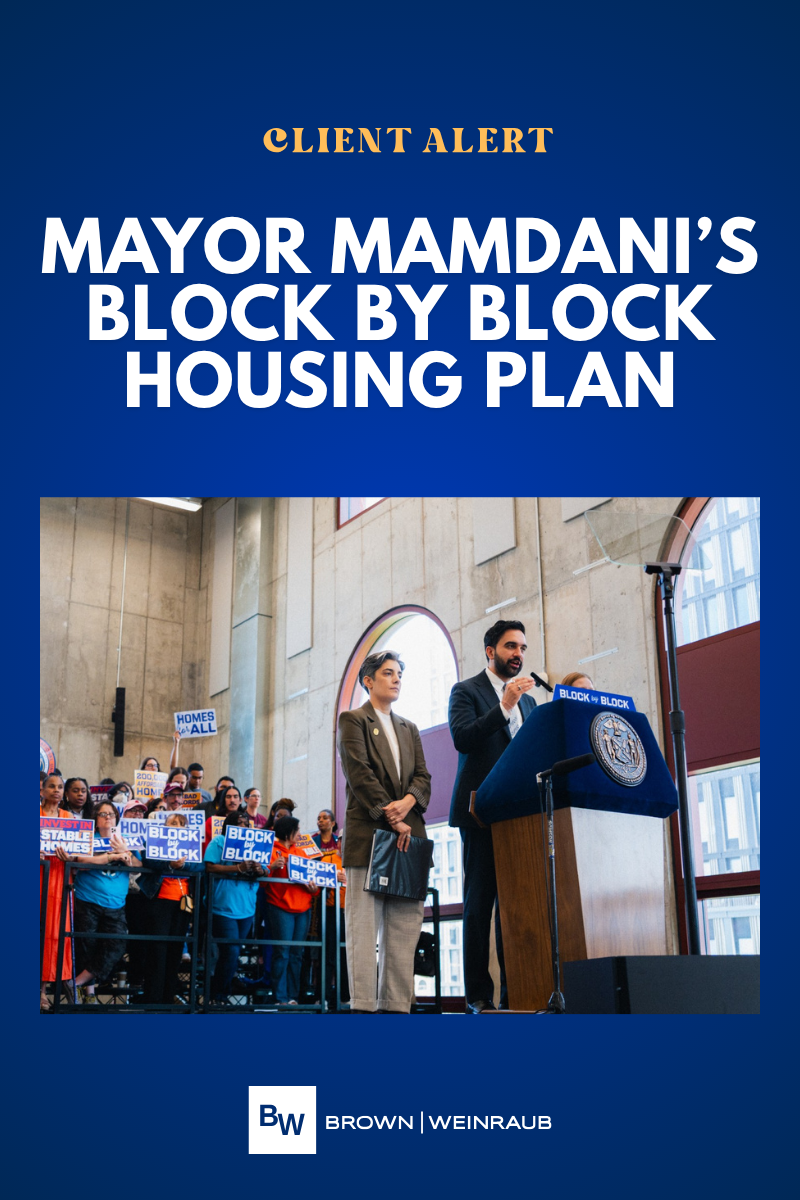
Mayor Mamdani released his housing plan this week – “Block by Block”. The extensive plan includes many themes that we have seen from previous administration, but also expands to include a focus on Tenants, Building Maintenance and NYCHA. The 8 chapters of the plan are a combination of highly specific proposals and broad goals that are intended to preserve 200,000 units of affordable housing and creating 200,000 new affordable housing units over the next 10 years.
But, in a positive step, Block by Block also includes many proposals that are intended to also benefit market-rate developments, and the plan explicitly acknowledges the needs to advance private development to achieve the City’s goals.
While much of the plan speaks to the need to strengthen enforcement actions against buildings, the plan also proposes to ease some mandates to reduce cost. Notably, the City has proposed a comprehensive code reform taskforce that will seek to reduce the cost of construction by removing outdated restrictions and it will run parallel to the current code updating cycle as to not delay any needed code updates.
Additionally, Block by Block specifically calls for reform of some regulations that add to construction or maintenance cost including allowing for fewer street wall inspections pursuant to Local Law XI; changing property tax assessments calculations to reduce taxes on many rent stabilized buildings by 1.3%; and allowing modern plastic plumbing similar to other cities.
The City will also seek to make changes to staffing and policies that add to the time and thereby cost of creating new housing. Notably, HPD is proposing to create a new mixed-income housing program that will allow market rate units to help subsidize affordable housing developments. This proposal, along with a proposed revolving loan fund to finance mixed-income projects, could help advance projects that otherwise will languish due to market conditions.
Further, the city is identifying places where the lack of staff slows the pace of review, including at the Department of Environment Protection (DEP), who is responsible for reviewing plans that excavate 20,000 SF of soil or add 5,000 SF of hard surfaces. The additional staffing and policies are intended to reduce review time of these plans from 7 months to as little as 45 days. Additional staff are proposed at DOB in units responsible for asbestos abatement, a necessary step in many office to residential conversions.
Finally the city is proposing to study easing regulations or policies that slow or inhibit development, including having the Landmarks Preservation Commission identify opportunities for new housing in historic districts; having DOB and EDC study ways to reduce construction cost by expanding pre-fabrication, modular design and other industrial construction methods; and exploring innovations at DOB to advance robotics, sensors and digital construction management tools to reduce hazardous tasks on construction sites.
The administration has committed to a pro-housing strategy, which includes rezonings to allow more private development. To support this policy, the administration will release a fair housing plan that focuses on supply growth this year. It will include 1) the city’s long-term housing needs assessment, 5-year targets for growth and a strategic framework to address barriers to new construction. The city will also focus Citywide Transit Oriented Developments focused on increasing supply near mass transit and the proposed new Interborough Express and Bus Rapid Transit routes. Finally, the plan identifies two neighborhoods for rezoning but acknowledges that more will be identified by working with local stakeholders:
Finally, the report anticipates that the recently approved SEQRA reforms will reduce pre-certification times for some ULURPS to 6 months instead of two years – saving time and money. And, in October, the city will release the 12 communities’ boards that have produced the fewest number of affordable units per capita. Those communities will be subject to an expedited ULURP process per the Charter amendments approved last year.
While the real estate community and the administration will certainly have points of disagreement with parts of the plan, many of the reforms noted above will have a positive effect on the industry’s ability to construct, convert and maintain properties.
As always the devils lie in the details and more will be released in the coming months and years, but the report creates a foundation of common ground that the Real Estate Industry and the Administration can build on.
Talk to your Brown & Weinraub team member or reach out to us with any questions. Written by Brown & Weinraub Senior Advisor Brian Cook. Contact Brian here.
Updates, news, and information for your industries.

