

May 19, 2026
(5 Min. Read)
On Tuesday, May 12, New York City Mayor Zohran Mamdani released his Executive Budget for Fiscal Year 2027, presenting a $124.7 billion all-funds financial plan and marking what the administration characterizes as the resolution of the City’s inherited fiscal imbalance. The Executive Budget reflects updated revenue forecasts, significant new state aid agreements, and a series of agency-led savings initiatives intended to close the previously projected budget gap fully.
The proposal reflects three central themes: (1) a record-level budget that is now described as fully balanced in FY 2027, following the elimination of a previously estimated multi-billion-dollar gap; (2) a fiscal strategy centered on agency savings, state support, and targeted revenue actions, with reduced reliance on broad-based tax measures; and (3) continued advancement of the administration’s affordability agenda, including childcare, transit, housing, and libraries, many of which are now more firmly supported through baseline funding and state partnerships.
Below is a summary of the Executive Budget financial plan and key reporting from the City’s official release and independent analysis.
Please do not hesitate to reach out to your B&W team member with any questions or requests for additional information.
Click here for Executive Budget Details
The FY 2027 Executive Budget totals $124.7 billion, representing a modest reduction from earlier projections and aligning with the administration’s revised fiscal framework. The budget is formally presented as balanced for FY 2027 without using the Rainy Day Fund or the Retiree Health Benefit Trust, and without new across-the-board service cuts.
A central shift in the Executive Budget is the administration’s claim that the City has moved from a projected multi-billion-dollar deficit to a balanced position, achieved through a combination of savings, state support, and revised expenditure assumptions.
Key fiscal developments include:
The administration emphasizes that the FY 2027 budget is balanced without drawing down core reserves and without the large-scale property tax increase previously discussed in earlier financial plans.
Unlike earlier budget scenarios, the Executive Budget does not rely on a 9.5% property tax increase as a primary gap-closing mechanism, reflecting both political resistance and the availability of alternative revenue and savings sources. This marks a significant shift from the Mayor’s preliminary budget after significant criticism from outer-borough single family homeowners and elected officials
A defining feature of the Executive Budget is the scale of state-level fiscal coordination, including:
Reporting indicates that a large portion of gap closure is attributed to state-supported savings and revenue actions rather than new city-level taxes alone.
At the same time, fiscal monitors continue to caution that many of these solutions rely on one-time or non-recurring measures, raising concerns about sustainability in the out years.
The Executive Budget includes several major investments and reallocations across key service areas, reflecting both affordability priorities and core public service funding:
The Executive Budget and related policy announcements underscore the administration’s continued emphasis on progressive revenue strategies targeting high-income earners.
The Executive Budget includes a major new investment package to support compliance with state-mandated class-size requirements and to strengthen instructional capacity across the public school system.
The Executive Budget expands the administration’s “Child Care for All” agenda through targeted investments aimed at increasing provider capacity, improving early education outcomes, and piloting new municipal models of care delivery:
The Executive Budget includes $4 billion in HPD capital funds in the five-year plan, plus an additional $500 million in FY31.
The Executive Budget includes a significant expansion of investment in NYCHA to support both comprehensive rehabilitation and faster occupancy of vacant units.
The FY 2027 Executive Budget includes $9 million annually to support new FDNY civilian staff who support emergency response and EMS capacity. It also provides $40 million annually to the Office of Community Safety, starting in FY27, to support crisis response and violence prevention systems that coordinate with EMS and 911 operations.
Also included are broad public safety and justice investment packages aimed at strengthening community-based prevention, expanding legal protections, and enhancing accountability and service capacity across multiple justice agencies.
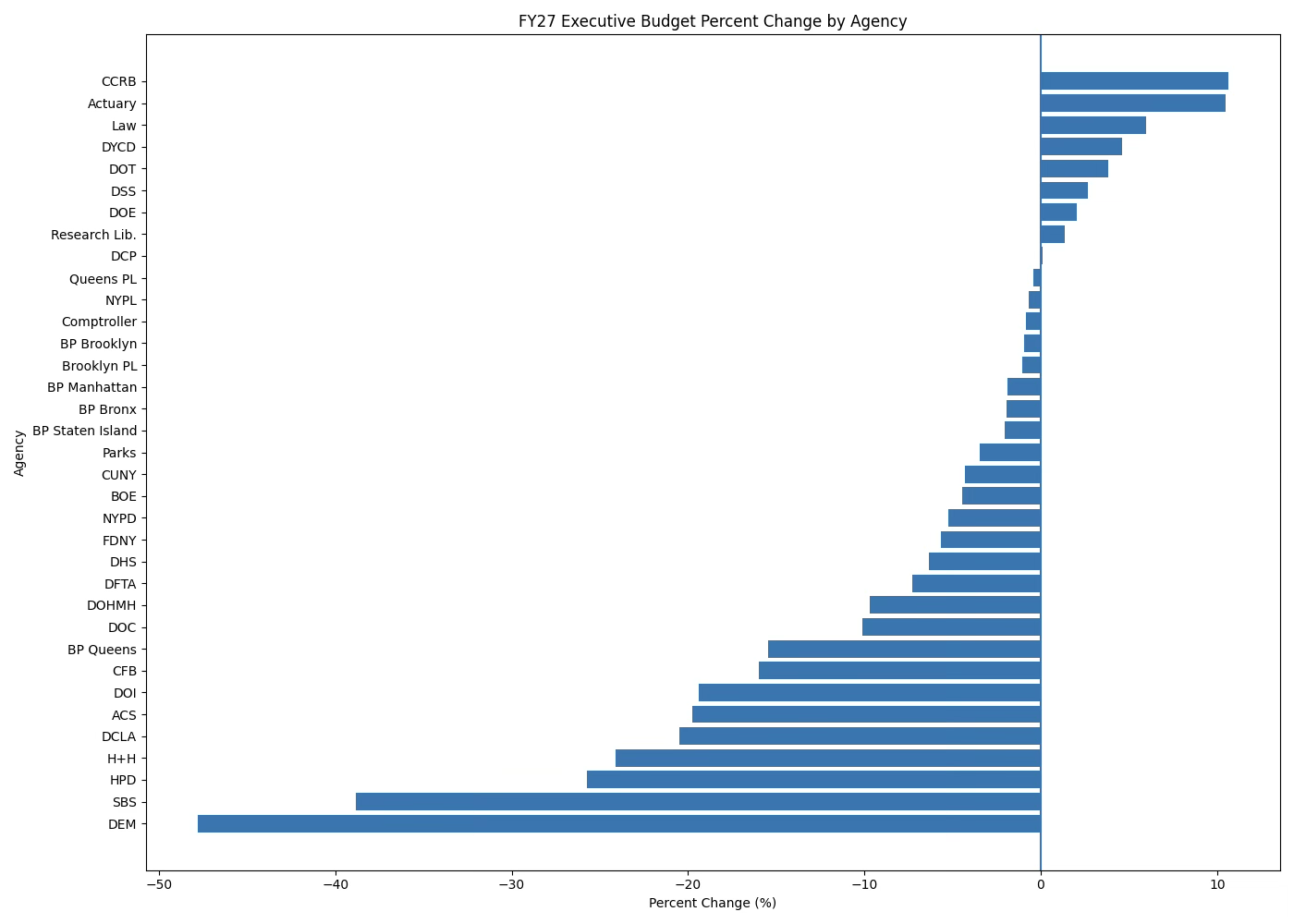
These targeted investments are set against a broader fiscal backdrop of agency-wide restraint and shifting spending priorities. While the Administration’s FY27 Executive Budget proposes new or expanded funding in select areas, the overall plan reflects funding changes across City agencies compared to the FY26 Adopted Budget.
Specifically, the FY27 Executive Budget reflects broad reductions in expense funding across many city agencies, particularly in housing, healthcare, emergency management, and public safety, while maintaining or increasing funding for education, youth services, and transportation.
The largest cuts were to the Administration for Children’s Services (ACS), which declined by $866.6 million (19.78%), Housing Preservation and Development (HPD), down $533.2 million (25.73%), and Health + Hospitals Corporation, down $553.8 million (24.08%). The Department of Emergency Management experienced one of the steepest percentage reductions, falling 47.81%.
Public safety agencies also saw notable decreases, including the Police Department (-5.24%), Fire Department (-5.64%), and Department of Corrections (-10.13%). Economic and cultural agencies also experienced substantial reductions, including the Department of Small Business Services (-38.82%) and the Department of Cultural Affairs (-20.51%).
At the same time, several agencies received targeted increases. The Department of Education saw the largest increase overall, rising by $767.9 million (2.07%), while the Department of Social Services increased by $381.1 million (2.68%). The Department of Youth and Community Development (+4.60%), Department of Transportation (+3.82%), and Civilian Complaint Review Board (+10.65%) also received additional funding.
Overall, the FY27 Executive Budget prioritizes education, social services, and select oversight and infrastructure functions, while scaling back spending in housing, healthcare, emergency management, and several public safety-related agencies.
The Executive Budget now enters the final phase of negotiations between the Mayor and the City Council, during which both revenue projections and spending priorities are expected to be revised before adoption. Over the next several weeks, the City Council will review and negotiate the proposed spending plan and must ultimately approve the budget before it can be formally adopted.
The City Council will also undertake a detailed review of the proposal and convene a second round of targeted budget hearings. The FY 2027 Adopted Budget must be finalized by June 2026, before the start of the new fiscal year on July 1.
Updates, news, and information for your industries.

